
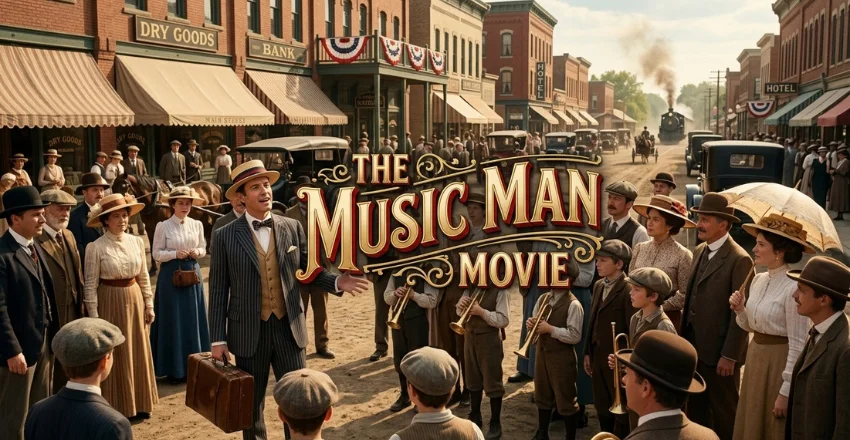
The Music Man movie turns a traveling con artist’s scheme into a colorful American musical comedy. Robert Preston leads the 1962 film as fast-talking salesman Harold Hill. Shirley Jones plays Marian Paroo, the librarian who threatens both his scheme and his carefully guarded heart.
The story combines romance, comedy, small-town conflict, and some famous musical numbers. It runs 151 minutes and was directed by Morton DaCosta. Its mix of rapid dialogue and large musical sequences still gives the film a distinctive personality.
The Music Man Movie at a Glance
| Detail | Information |
|---|---|
| Release year | 1962 |
| U.S. release | June 19, 1962 |
| Director | Morton DaCosta |
| Main stars | Robert Preston, Shirley Jones, Buddy Hackett |
| Setting | River City, Iowa |
| Genre | Musical comedy |
| Runtime | 151 minutes |
| Language | English |
| Rating | G |
| Studio | Warner Bros. Pictures |
| Source material | Meredith Willson’s Broadway musical |
Direct answer: The film follows con man Harold Hill as he sells River City residents on a boys’ band he cannot teach. His plan changes after he meets librarian Marian Paroo and becomes attached to the community. The result blends romance, comedy, deception, and memorable music into a classic Hollywood musical.
What Is The Music Man Movie About?
Harold Hill arrives in River City, Iowa, with a well-practiced sales scheme. He claims the town’s children need a boys’ band. He plans to sell instruments and uniforms, then disappear with the money.
Hill first needs to create a problem that his band can supposedly solve. He focuses on a new pool table and warns parents about its influence. His confidence quickly wins over much of the town.
One person remains difficult to fool. Marian Paroo is River City’s librarian and piano teacher. She questions Hill’s credentials and starts looking for evidence against him.
Hill responds by trying to charm Marian while continuing his scheme. Yet his connection with her gradually becomes more sincere. His influence on Marian’s younger brother, Winthrop, also complicates her view of him.
The deception eventually catches up with Hill. He must decide whether to flee as usual or face River City. That choice gives the musical comedy an emotional center beyond its songs and jokes.
Robert Preston Makes Harold Hill Hard to Ignore
Robert Preston had already played Harold Hill on Broadway before taking the role to film. That experience shows in the speed and confidence of his performance. He makes Hill feel like a salesman who can control a room before anyone questions him.
Hill’s greatest weapon isn’t musical knowledge because he has little of it. His talent is persuasion, timing, and understanding what people want. Preston communicates those traits through speech, movement, and musical performance.
The character also needs enough warmth for his later change to feel believable. Preston gradually shifts Hill from opportunistic outsider to someone with genuine ties. That development keeps the story from becoming a simple tale about exposing a fraud.
Shirley Jones Gives Marian More Than a Romantic Role
Shirley Jones plays Marian as intelligent, skeptical, and unwilling to accept Hill’s claims without evidence. Her suspicion gives the story necessary resistance. Without Marian, Hill’s success would come too easily.
Marian also sees changes that aren’t part of his intended con. Winthrop becomes more engaged after the promise of joining a band. River City’s residents begin organizing, rehearsing, and interacting differently.
Those effects force Marian to consider a difficult question. A dishonest person can still cause positive changes that he never planned. Her developing feelings for Hill grow from that tension rather than simple attraction.
The Cast Brings River City to Life
The supporting cast gives the town its comic rhythm and social energy. Buddy Hackett plays Marcellus Washburn, an old associate of Hill. Paul Ford and Hermione Gingold play Mayor Shinn and his wife, Eulalie.
Pert Kelton appears as Mrs. Paroo, while young Ron Howard plays Winthrop. The Buffalo Bills portray members of the school board. Their barbershop singing becomes one of the film’s recurring musical pleasures.
These characters also make River City feel crowded and reactive. Gossip spreads quickly, committees form, and personal disagreements become public business. Hill succeeds partly because he understands how to redirect that collective energy.
The Songs Are Central to the Story
The musical numbers don’t merely interrupt the plot for entertainment. Several reveal how Hill persuades people or how relationships change. Meredith Willson’s music gives different characters recognizable styles and rhythms.
“Ya Got Trouble” shows Hill manufacturing fear around River City’s pool table. “Seventy-Six Trombones” turns his sales pitch into a grand vision of a marching band. Together, those numbers demonstrate why townspeople find his promises persuasive.
“Till There Was You” moves in another direction. Its quieter romantic tone reflects the growing bond between Harold and Marian. “The Wells Fargo Wagon” captures the town’s excitement as promised deliveries begin arriving.
Other memorable numbers include “Rock Island,” “Marian the Librarian,” and “Gary, Indiana.” “Shipoopi” adds another burst of comic energy. The score shifts easily between patter, romance, ensemble singing, and parade music.
Why the River City Setting Works So Well
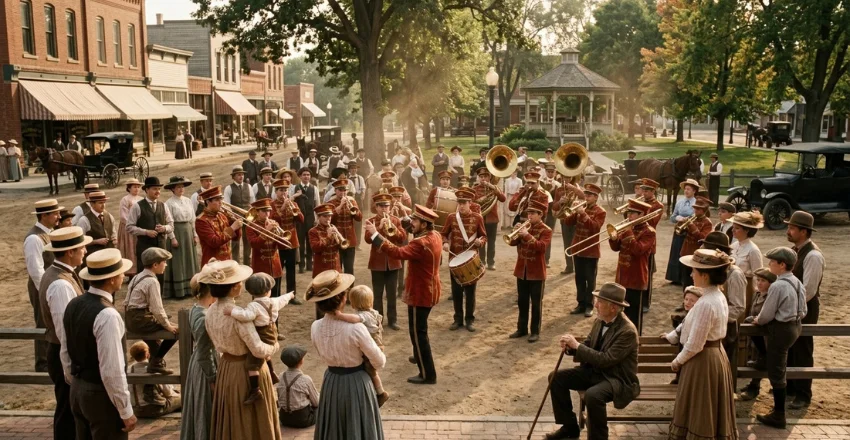
The story takes place in Iowa during the early twentieth century. River City is fictional, but its social structure matters greatly. Everyone seems to know everyone else’s habits, family, and reputation.
That environment creates an ideal setting for Harold Hill’s scheme. News spreads fast, yet excitement can spread even faster. Once influential residents accept his idea, social momentum starts doing some selling for him.
The setting also makes Marian’s position more interesting. She values books and education in a community that can become suspicious of unfamiliar ideas. Her skepticism toward Hill fits her broader habit of thinking independently.
What the Movie Is Really Saying About Persuasion
Hill doesn’t begin by proving that River City needs a band. He first convinces residents that they face a serious problem. Only then does he present himself as the person with a solution.
That pattern makes the story surprisingly sharp about salesmanship. Fear creates urgency, while spectacle creates desire. Social pressure then helps turn an individual pitch into a community movement.
Yet the film doesn’t treat persuasion as purely negative. Hill’s dishonest pitch still encourages music, confidence, and community activity. The tension comes from separating those benefits from the deception used to produce them.
Is The Music Man Family-Friendly?
The 1962 film carries a G rating. Its central wrongdoing involves fraud, lying, and manipulation rather than graphic material. Some romantic behavior and dated language reflect the era in which the film was made.
Parents should also consider the 151-minute runtime. Younger viewers may find a two-and-a-half-hour musical demanding. Families who enjoy classic musicals may find its songs and broad comedy easier to follow.
The story can also prompt useful discussion with older children. Harold’s charm doesn’t make his deception acceptable. His actions provide an accessible example of why persuasive people still deserve careful scrutiny.
How the Film Differs From Many Modern Musicals
The movie doesn’t hide its stage origins. Large ensemble scenes, stylized movement, and theatrical transitions remain central to its presentation. That quality may feel unusual to viewers raised on faster contemporary editing.
The pacing also gives musical numbers room to develop. Songs often carry character information and plot movement instead of serving as brief breaks. Viewers willing to accept that rhythm get a clearer sense of the original stage show’s structure.
Its visual scale adds something the theater cannot reproduce in the same way. Streets, crowds, costumes, and parade imagery expand River City beyond a stage. The result sits comfortably between theatrical performance and classic Hollywood filmmaking.
Awards and the Film’s Place in American Culture
The production received six Academy Award nominations, including Best Picture. Ray Heindorf won for the film’s musical scoring. Those honors reflect the scale of its music and production.
The movie later received another major form of recognition. The Library of Congress selected it for the National Film Registry in 2005. Registry selections are recognized for cultural, historical, or aesthetic significance.
That status helps explain why the film remains more than a nostalgic curiosity. Its songs have continued to circulate far beyond the original release. Its portrait of salesmanship and small-town excitement also remains easy to recognize.
Where Can U.S. Viewers Watch It?
Streaming availability changes as licensing agreements move between services. U.S. viewers should check current listings before assuming an older listing still applies. Availability can differ between free streaming, rentals, purchases, and library services.
As of September 2026, current U.S. listings show free ad-supported and library-based options alongside digital rentals and purchases. Plex, Tubi, and Hoopla appear among current options. Amazon Video and the Apple TV Store also appear in current rental or purchase listings.
Because these arrangements can change without notice, confirm the service before planning a movie night. Prices can change for the same reason. A current streaming search is more reliable than an older review page.
Why the 1962 Film Still Works
The strongest reason to revisit this movie is Robert Preston’s central performance. He gives Hill enough speed and confidence to make the character’s influence understandable. He also lets uncertainty surface as Hill’s relationship with Marian changes.
The score provides another reason. Major songs have clear dramatic jobs rather than existing as decoration. Comedy, persuasion, romance, and community excitement all receive distinct musical treatment.
The story also has more bite than its bright colors suggest. River City is manipulated because residents respond to fear and group pressure. That idea remains recognizable decades after the movie’s release.
Frequently Asked Questions
When was the music man movie released?
The U.S. release took place on June 19, 1962. The film also premiered in Mason City, Iowa, which was composer Meredith Willson’s hometown. Warner Bros. Pictures distributed the production.
Who plays Harold Hill?
Robert Preston plays Professor Harold Hill. He had originated the character in the Broadway production before appearing in the film. His familiarity with the part shapes the movie’s fast verbal and musical rhythm.
Who plays Marian Paroo?
Shirley Jones plays Marian Paroo, River City’s librarian and piano teacher. Marian initially distrusts Hill and investigates his background. Her relationship with him becomes one of the story’s central conflicts.
How long is the film?
The official runtime is 151 minutes. That equals two hours and 31 minutes. Viewers planning a family screening may want to account for the longer classic-musical format.
What are the most famous songs?
“Seventy-Six Trombones” and “Ya Got Trouble” are among its most recognizable numbers. “Till There Was You” is another major song from the score. The film also features “Rock Island,” “Shipoopi,” and “The Wells Fargo Wagon.”
Is the story based on a stage musical?
Yes, the film adapts Meredith Willson’s successful stage musical. The Broadway production opened before the movie adaptation arrived in 1962. Morton DaCosta directed both the Broadway production and the movie adaptation.
A Classic Musical Worth Meeting in River City
Viewers who enjoy classic Hollywood musicals will find plenty to appreciate here. Readers curious about another side of Hollywood can also read this look at the Kelly McGillis and Tom Cruise relationship. The film offers energetic performances, memorable songs, colorful production design, and an unusually charismatic central character. Its long runtime asks for patience, but the story keeps returning to character and conflict.
New viewers may come for “Seventy-Six Trombones” or Robert Preston’s famous performance. They may stay for the sharper story about persuasion, trust, and community behavior. For your next classic-movie night, River City remains an entertaining place to visit.