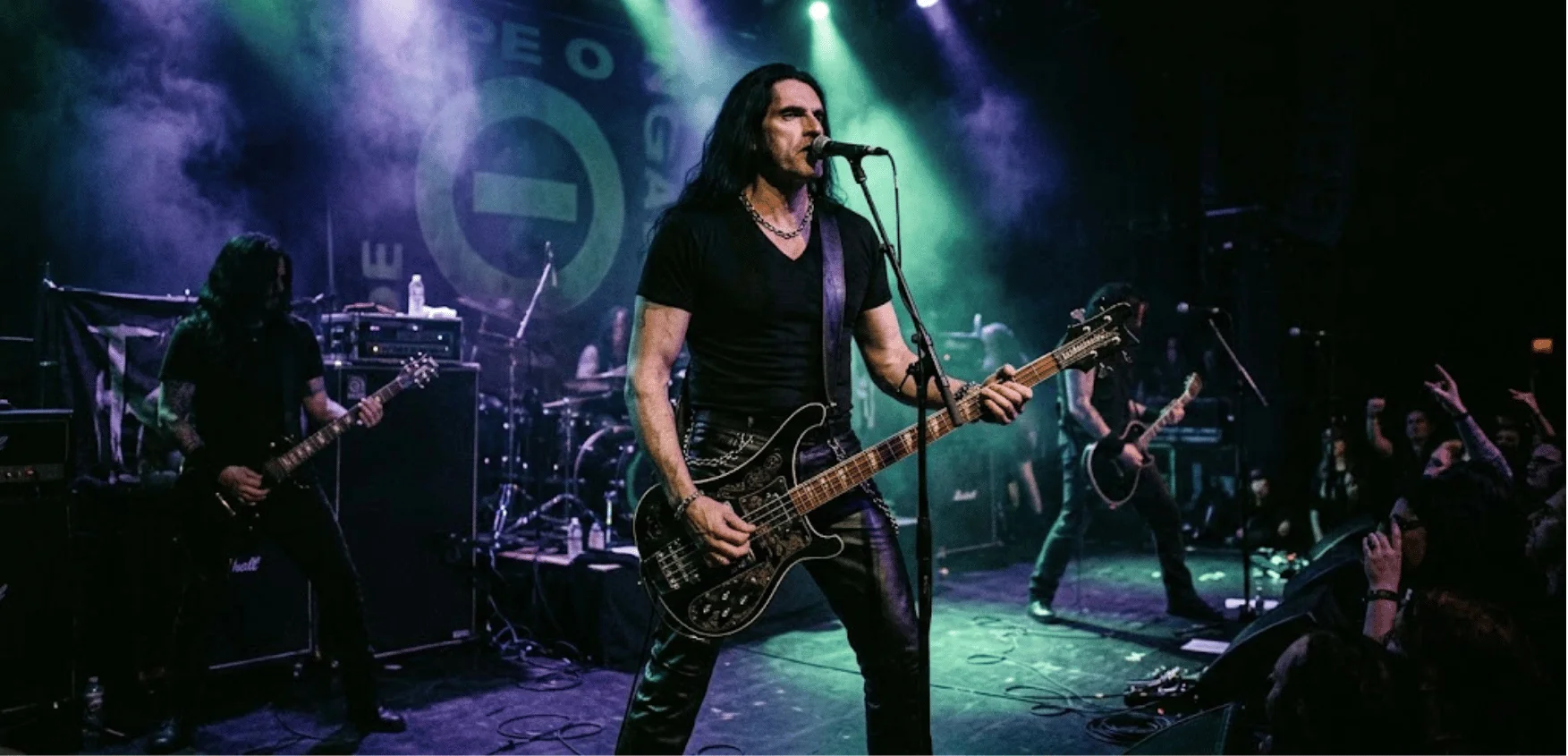
Peter Steele was the Brooklyn-born singer, bassist, and primary songwriter of Type O Negative. Known for his 6-foot-8 frame, bass-baritone voice, dark humor, and personal lyrics, he helped make the band a defining American gothic-metal act. He died in 2010 at age 48, but his audience continues to grow.
His story stretches far beyond the image of a towering frontman dressed in black and green. It includes years working for New York City, a career that moved from thrash to gothic metal, public controversy, private struggles, and music that keeps finding new listeners.
| Key fact | Detail |
|---|---|
| Full name | Peter Thomas Ratajczyk |
| Born | January 4, 1962, Brooklyn, New York |
| Died | April 14, 2010, age 48 |
| Height | About 6 ft 8 in (2.03 m) |
| Main role | Singer, bassist, songwriter |
| Best known for | Type O Negative |
| Earlier bands | Fallout and Carnivore |
| Major albums | Bloody Kisses, October Rust, World Coming Down |
| Notable songs | “Black No. 1,” “Love You to Death,” “I Don’t Wanna Be Me” |
| Marriage and children | He said in 2007 that he was unmarried and had no children |
The basic biographical details are supported by contemporary reporting, music references, and specialist biographical sources.
Who Was Peter Steele?
He was born in Brooklyn and grew up as the youngest of six children. Music entered his life early. He started guitar lessons around age 12, then moved to bass about six months later.
Before music became his full-time work, he held a city job with the New York City Parks Department. His duties included maintenance work and operating heavy vehicles around the Brooklyn Heights Promenade. He eventually became a supervisor.
That job also helps explain his “Green Man” nickname. Green later became central to Type O Negative’s visual identity.
For another music-focused biography on the site, readers can visit Readsbest’s Lukas Graham profile.
From Carnivore to Type O Negative
His early music was much more aggressive than the sound that later made him famous. Fallout came first, followed by Carnivore, a Brooklyn metal band built around thrash, hardcore, and confrontational lyrics.
Carnivore released two studio albums before breaking apart. Steele later carried parts of that heaviness into a slower and more atmospheric project.
Type O Negative formed in Brooklyn around 1989. The core lineup included Steele, guitarist Kenny Hickey, keyboardist Josh Silver, and drummer Sal Abruscato. Johnny Kelly later replaced Abruscato.
The band’s 1991 debut, Slow, Deep and Hard, mixed long songs, distorted guitars, keyboards, theatrical vocals, and harsh humor. The approach became more melodic over the next few years.
The Album That Changed Everything
The major breakthrough arrived with Bloody Kisses in 1993. Songs such as “Black No. 1” and “Christian Woman” gave the group a much larger audience.
The album eventually earned platinum certification in the United States. October Rust, released in 1996, later earned gold certification. Current RIAA records list both releases among the band’s certified works.
October Rust pushed the melodic side further. Its best-known tracks include “Love You to Death” and “My Girlfriend’s Girlfriend.” AllMusic describes the record as a more accessible variation on the band’s established gothic sound.
That movement between heaviness and melody became one of the group’s strongest qualities.
Readers interested in other entertainment careers can also browse Readsbest’s Norman Reedus profile.
Why His Voice and Style Were So Distinctive
Steele’s size made him difficult to overlook, but his voice mattered more. His unusually low register gave Type O Negative an identity that few other metal bands could copy.
The music combined doom-metal weight with gothic atmosphere, keyboards, melodic passages, and flashes of punk or thrash. AllMusic classifies the group within goth metal, alternative metal, and heavy metal.
His songwriting was equally recognizable. Love, rejection, mortality, addiction, religion, and self-disgust appeared repeatedly in the lyrics.
Dark humor often sat beside those themes. That made it risky to read every line as a literal statement. Steele frequently aimed the joke at himself as much as anyone else.
The Playgirl Appearance and His Public Image
His public profile expanded sharply in 1995 when he appeared nude in the August issue of Playgirl. The feature became one of the most discussed episodes of his career.
In a later interview, he said the magazine paid him $2,000. He also described the shoot as something he initially treated as a joke and publicity opportunity.
The appearance reinforced his status as an unlikely rock sex symbol. It also showed the tension between his imposing public image and his self-deprecating personality.
Readsbest covers other figures whose public image became part of their celebrity story, including its Megan Fox profile.
His Personal Life Was Less Simple Than the Persona
The singer’s romantic life inspired a large share of his writing, but reliable public information is more limited than fan speculation suggests.
In a 2007 interview, he said he was unmarried and had no children. He also said he wanted a wife and family. That direct statement is more useful than later rumors about secret marriages or children.
Relationships, breakups, family losses, substance use, and emotional struggles shaped much of his later work. Interviews from different periods show that those subjects were not only part of a stage character.
Still, his public interviews often mixed sincerity with jokes. Claims about his private life should be treated carefully unless they come from a clear source.
How He Died and Why the Reports Differ
Steele died on April 14, 2010, at age 48.
Early reports said heart failure appeared to be the cause. CBS quoted the band’s manager at the time saying that heart failure was the preliminary explanation.
Later biographical material connected to his estate reports a more specific cause: sepsis caused by diverticulitis. It notes that heart failure was the initial report rather than the final explanation.
That distinction matters because older articles still repeat the first reports. Some other sources have also named an aneurysm, which adds to the confusion.
He had been preparing for more music before his death. The surviving members chose not to continue Type O Negative with a replacement singer.
Why His Music Still Matters in 2026
The most interesting evidence of his continued reach is recent.
On June 15, 2026, “I Don’t Wanna Be Me” received an RIAA gold certification after reaching 500,000 certified US units. It became Type O Negative’s first RIAA-certified gold single.
The song came from 2003’s Life Is Killing Me. More than two decades later, it reached a new commercial milestone in the United States.
That result shows how the band’s audience has moved beyond the original 1990s fan base. Streaming, social platforms, reaction videos, and renewed interest in gothic music have given the catalog another life.
His influence also reaches artists who value deep vocals, slow tempos, romantic gloom, and humor that never becomes completely separate from the sadness.
For more celebrity and culture coverage, explore the Readsbest Entertainment section.
The Lasting Appeal
Steele created a sound that was difficult to separate from the person performing it. His voice, appearance, humor, and writing made Type O Negative instantly recognizable.
Yet the strongest part of his legacy is the music’s staying power. A song earning a new US gold certification in 2026 shows that the catalog is still reaching people years after the band ended.
If you are discovering the group for the first time, start with “Bloody Kisses” and “October Rust”. Then move to World Coming Down for the darker side of the story.
Frequently Asked Questions
He was widely listed at about 6 feet 8 inches (2.03 meters). Several profiles list him at 6-foot-7, but specialist biographies and major obituary coverage commonly list him at 6-foot-8.
He was born Peter Thomas Ratajczyk on January 4, 1962, in Brooklyn, New York. Some older coverage uses the form Petrus T. Ratajczyk.
In a 2007 interview, he said he was unmarried and had no children. He also spoke about wanting to marry and start a family.
The first reports pointed to heart failure. Later estate-linked biographical information identified sepsis caused by diverticulitis as the cause.
“Black No. 1,” “Christian Woman,” “Love You to Death,” “My Girlfriend’s Girlfriend,” and “I Don’t Wanna Be Me” offer a useful introduction. They cover the band’s gothic, romantic, melodic, and heavier sides.